Portfolio reference implementation built on public U.S. Census Bureau ACS PUMS microdata. Not affiliated with any actual federal program or agency. Views and architectural choices are my own.
Most AI systems don’t fail because the model is wrong. They fail because governance was never engineered into the system.
In high-stakes environments, a model that is 99% accurate but 0% auditable isn’t an asset. It’s a liability.
The Problem
We’ve optimized AI for speed of deployment. But in enterprise and federal settings, where decisions impact eligibility, credit, or livelihoods, velocity without accountability is dangerous.
Rule-based systems are auditable by design. ML systems are not. Governance has to be engineered into the surrounding system — because it cannot be read out of the model itself.
Most production ML systems still look like this:
- Black-box models with no audit trail
- Monitoring without enforcement
- No enforceable fairness controls
- Design decisions with no documented rationale
In regulated environments, “we’ll catch it in monitoring” is not a risk management strategy.
What’s needed instead is a system where governance is enforced by design, not added after deployment.
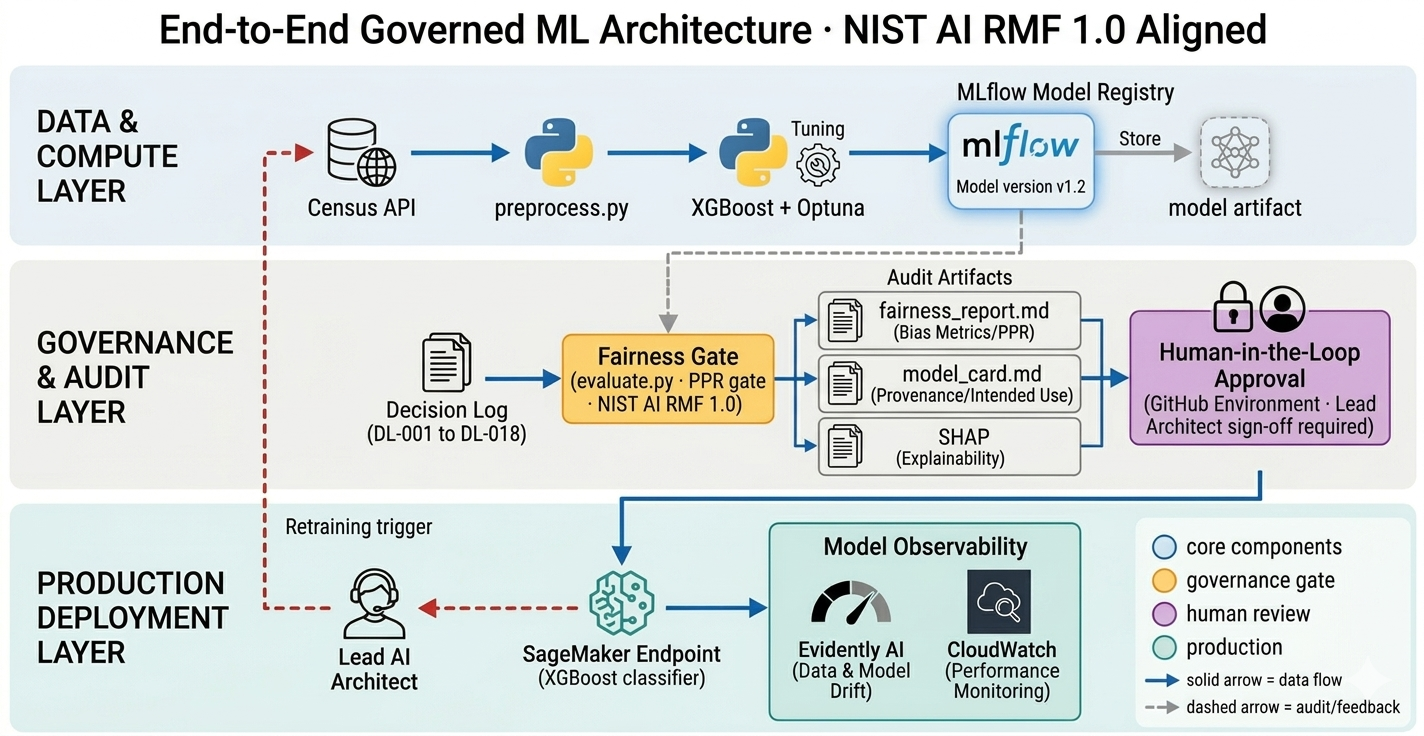
The System
I designed a governed ML system for income-based risk scoring using U.S. Census Bureau microdata — the same class of data that underpins federal program eligibility decisions.
Model complexity was earned, not assumed. Logistic Regression → Ridge → XGBoost. Each transition justified by demonstrated improvement.
But the model isn’t the point. The system is.
- Fairness is enforced as a CI/CD gate using PPR, aligned to EEOC and federal disparate impact standards. Any violation fails the pipeline. No deployment. No override.
- SHAP explanations are generated at inference time as the evidentiary basis for human review—not as a debugging convenience.
- Every architectural decision is recorded in a versioned decision log.
- Deployment requires explicit human approval via an environment-level control.
The constraint is mechanical, not cultural.
The Real-World Tradeoff
False negative: deny a qualified individual. False positive: allow a non-qualified individual.
The system is tuned to recover ~85% of qualifying individuals, accepting more false positives as the deliberate tradeoff.
This is a policy decision, not just a model outcome.
A Note on Model Complexity
The industry is racing toward agentic AI. The governance debt being accumulated in that race is significant and largely unacknowledged.
A well-governed classical ML system on structured data delivers deterministic outputs, interpretable by design, auditable at every inference, at sub-millisecond latency and cents per thousand predictions.
This is not a legacy pattern. In many enterprise and federal contexts, it is the architecturally correct choice.
In classical ML, outputs are deterministic and reproducible. Explainability can be engineered reliably.
In generative systems, non-deterministic outputs make that engineering significantly harder.
Complexity that cannot be audited is not sophistication. It is risk transferred to the organization.
Closing Thought
The future of AI won’t be defined by model performance benchmarks. It will be defined by the rigor of the controls that determine which models reach production—and the integrity of the evidence trail that proves those controls held.
Related
Reference implementation: Responsible MLOps Risk Engine
Authorization deep-dive: Beyond Security: Authorizing Trustworthy AI Systems in Federal Environments