Predictions
Responsible MLOps Risk Engine
From Model Accuracy to System Accountability
Governed MLOps architecture for regulated ML deployment, including fairness controls, CI/CD governance gates, model observability, and audit-ready documentation aligned to NIST AI RMF.
Executive Case Study
Problem. Organizations increasingly use machine learning to support decisions that affect eligibility, risk, fraud detection, benefits administration, lending, and other high-impact outcomes. While MLOps platforms have matured around model training and deployment, governance often remains dependent on documentation reviews, manual approvals, and procedural controls that are difficult to enforce consistently at scale.
As machine learning systems move into regulated and high-accountability environments, organizations must demonstrate not only model performance but also fairness, explainability, human oversight, auditability, and adherence to governance requirements. The architectural challenge is ensuring these requirements become enforceable system controls embedded throughout the lifecycle rather than review activities performed after deployment decisions have already been made.
This project demonstrates a governed MLOps architecture that embeds fairness evaluation, approval workflows, observability, and audit evidence directly into the model lifecycle. A workforce analytics scenario using public U.S. Census Bureau ACS PUMS data serves as a representative use case; a decision-support context where accountability requirements are concrete and measurable.
Constraints. The system must demonstrate measurable fairness across race, sex, and nativity groups before it can be promoted, not after.
Decisions.
Three decisions drove the architecture. First, the Census sampling weight (person_weight) is excluded as a model feature; it is a survey artifact, not a personal characteristic, and used only as XGBoost’s sample_weight to produce population-representative predictions. Second, logistic regression was run to completion (AUC 0.91) before XGBoost was introduced, confirming the linear ceiling and earning the added complexity. Third, sensitive attributes are physically separated at preprocessing and never reach the model; they are rejoined only for post-prediction fairness auditing.
Architecture Thesis
Traditional MLOps platforms focus on training, deployment, and monitoring. In regulated environments, organizations must also demonstrate fairness, explainability, human oversight, auditability, and policy compliance. This project treats governance as an enforceable system property rather than a procedural review activity.
Fairness Gate
In continuously retrained ML environments, fairness assessments must operate as deployment controls rather than periodic review activities.
evaluate.py exits with code 1 if any demographic group’s Positive Prediction Rate deviates from the overall rate by more than ±0.20, blocking CI/CD deployment. Virginia-data fairness audit passed; all 10 demographic groups within threshold, PPR range 0.167 to 0.413 across race groups.
Human Accountability Boundary
Production deployment requires explicit human approval via a GitHub Environment gate before the deployment job executes. No automated path to production exists. The approval is logged as a named accountability record.
Outcomes
Model Outcomes
- AUC: 0.9506
- F1 Score: 0.7633
- Recall: 0.8546
- Precision: 0.6896
Governance Outcomes
- Fairness evaluation integrated into CI/CD promotion workflow
- Automated deployment gate blocks on demographic threshold violations
- Human approval checkpoint required before production release
- Drift monitoring via Evidently AI; 9 CloudWatch metrics per run
- Audit-ready evidence package aligned to NIST AI RMF across GOVERN, MAP, MEASURE, and MANAGE functions
Architecture
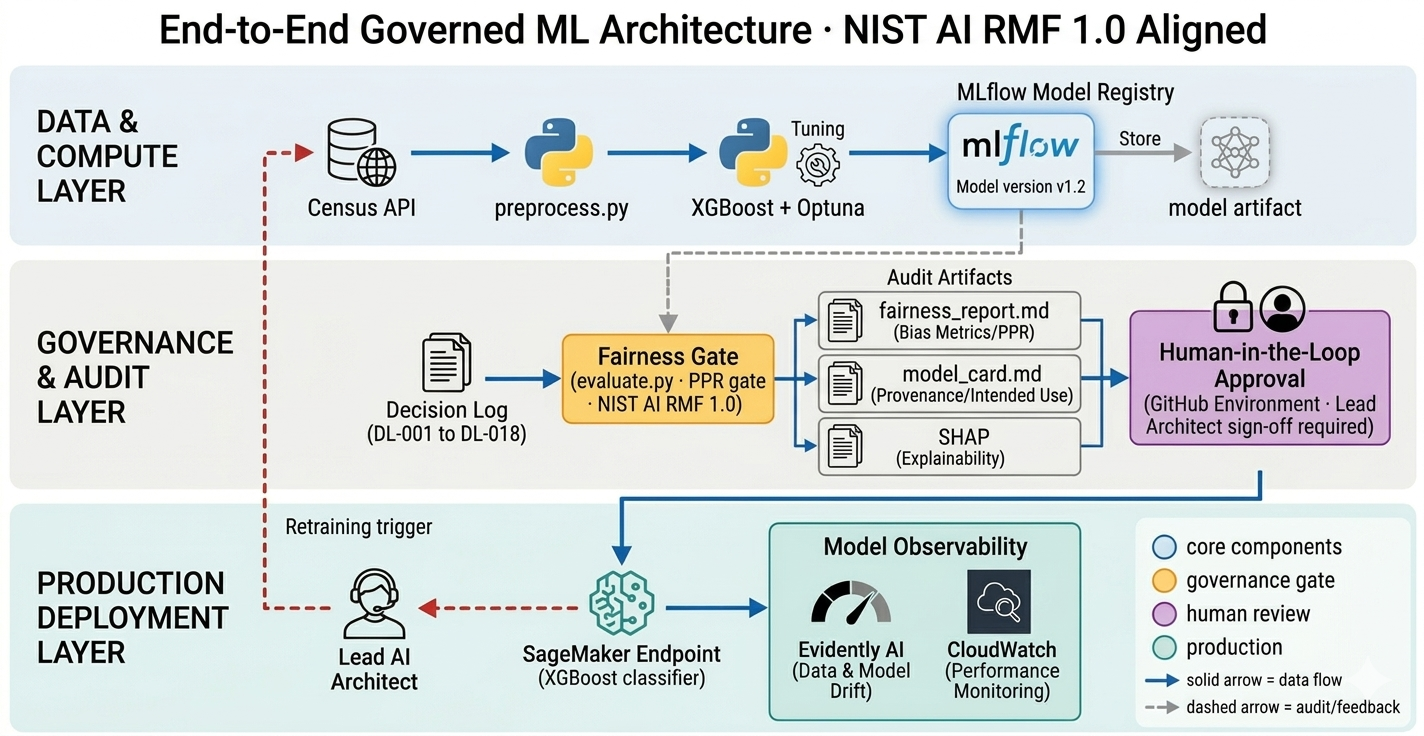
Three-layer architecture; Data and Compute, Governance and Audit, Production Deployment; with a structural fairness gate that exits CI/CD on demographic threshold violations.
Related
- Federal ATO package: Federal_ATO_Package_Responsible_MLOps_v1.0.pdf
- Companion article: Beyond Predictions: From Model Accuracy to System Accountability
- Authorization deep-dive: Beyond Security: Authorizing Trustworthy AI Systems in Federal Environments
Portfolio demonstration only. Built on public U.S. Census Bureau ACS PUMS microdata to illustrate governed ML architecture patterns. Not affiliated with any federal agency or production system. Views and implementations are my own.
Stack
- XGBoost
- Optuna
- MLflow
- Evidently AI
- SageMaker
- Terraform
- AWS S3
- GitHub Actions
- Scikit-learn
- Pandas
- ACS PUMS 2023