Reasoning
The Trust Layer for Enterprise Agentic AI
Beyond Autonomy: Governing Autonomous AI in Production
Governed agentic AI architecture for federal compliance workflows — a LangGraph state machine instrumented against a trust ledger, with policy enforcement at every tool boundary, evidence lineage on every retrieved item, and a hard human approval gate before any assessment artifact is released. The governance framework is the deliverable. The agent is the proof it works.
Executive Case Study
Problem. Traditional AI governance approaches were developed for systems that generate predictions or responses rather than take actions. Agentic systems introduce a fundamentally different challenge: they can plan, invoke tools, make decisions, and execute multi-step workflows with varying degrees of autonomy.
As organizations explore agentic AI for operational and regulatory workflows, questions of accountability become significantly more complex. Who approved an action? What information informed a decision? Which controls constrained the agent’s behavior? How can organizations demonstrate that governance requirements were enforced throughout execution?
The architectural challenge is not simply building capable agents. It is designing systems where autonomy remains bounded, observable, auditable, and subject to human oversight. This project demonstrates a governed agent architecture that applies approval checkpoints, bounded tool execution, policy controls, and audit trails to an AI-driven compliance evidence collection workflow.
Why Traditional Governance Breaks Down. Unlike predictive ML systems and retrieval systems, agentic systems can take actions rather than simply generate outputs. As autonomy increases, governance can no longer focus exclusively on model behavior; it must also govern tool usage, escalation paths, approval boundaries, and accountability for outcomes, enforced before execution rather than reviewed after.
Constraints. Every tool call validated against a governance contract. Every retrieved item carries evidence lineage. No assessment artifact released without explicit human approval. Agent authority is bounded below the level of self-authorization.
Decisions. The agent is implemented as a LangGraph state machine with explicit node transitions, not a free-form reasoning loop. Tool permissions are defined as an explicit allow-list with rationale; the agent cannot call tools outside its declared boundary. Human approval is a hard gate, not a soft checkpoint; no code path exists that bypasses it. Every decision is written to a runtime audit log at execution time, not reconstructed afterward.
Architecture Thesis
The value of agentic AI comes from autonomy, but autonomy without governance creates operational and accountability risks. Agent architectures should therefore be designed around explicit trust boundaries, bounded authority, human oversight, and auditable decision paths rather than deferring governance to post-execution review.
Reference Implementation
This architecture is demonstrated through a compliance evidence collection workflow: an agent that autonomously collects audit evidence for NIST 800-53 AC-family controls, assesses sufficiency, and generates cited compliance assessments.
The compliance workflow is the demonstration scenario. The governed agent architecture is the deliverable.
Outcomes
Governance Outcomes
- Human approval checkpoints enforced before any artifact released
- Tool execution bounded by explicit policy contract
- Audit trail generated for every agent action at execution time
- Trust boundary established between retrieval and execution layers
- Evidence integrity validated through provenance tracking
- Circuit breakers implemented for unsafe or out-of-scope behavior
- Adversarial scenario coverage: prompt injection via retrieved evidence tested and contained
- 19-scenario evaluation suite covering happy path, operational failure modes, and adversarial cases
Technical Outcomes
- Multi-step workflow orchestration via LangGraph state machine
- Knowledge retrieval integration with governed RAG layer
- Agent state management across tool calls
- Deterministic tool execution framework with explicit allow-list
Architecture
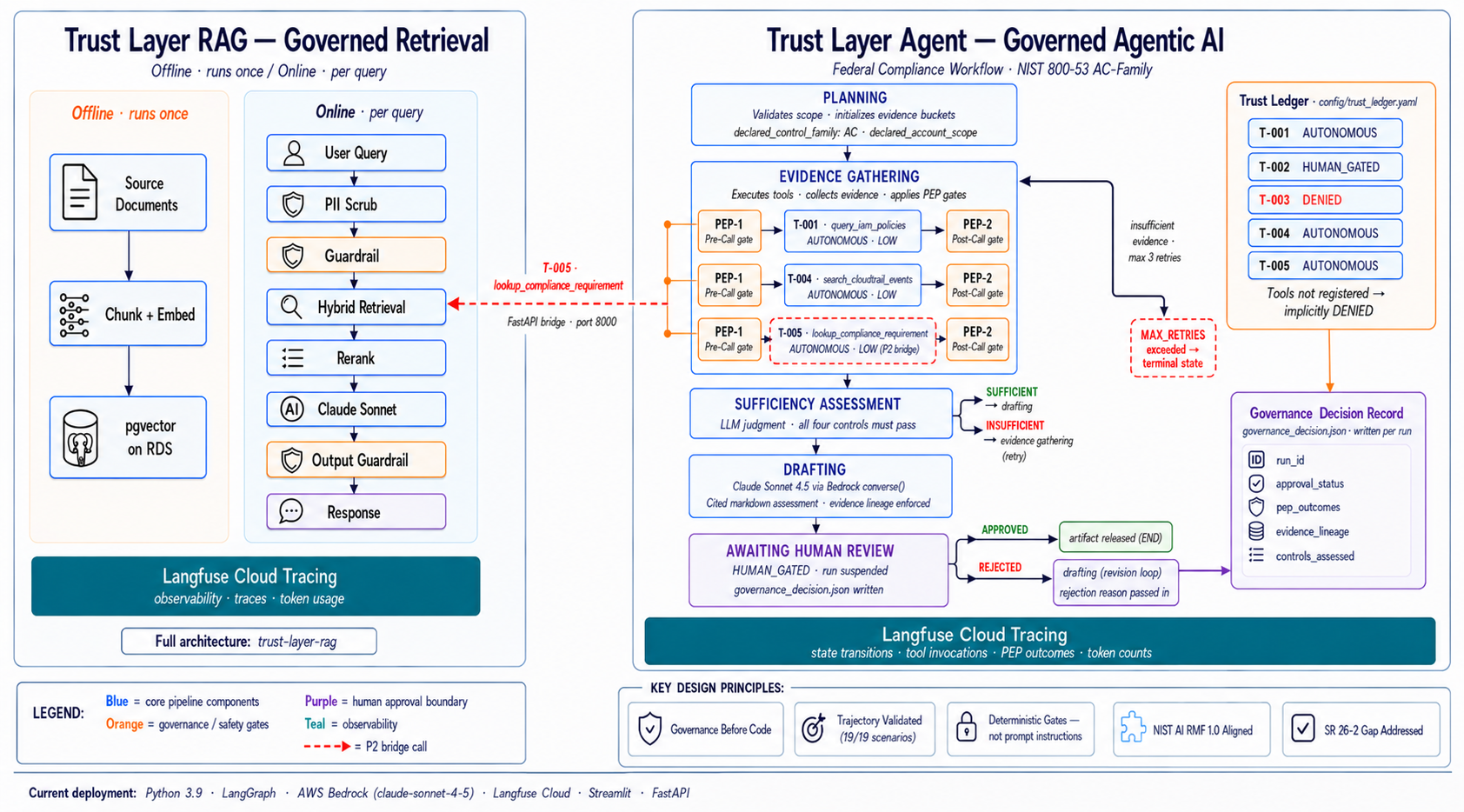
LangGraph state machine with five nodes, three tool permission tiers, and a hard human approval gate before assessment submission.
Related
- Companion article: Beyond Autonomy: Architecting the Trust Layer for Agentic AI
- Retrieval layer: The Trust Layer for Retrieval Systems
Portfolio demonstration only. Built on synthetic IAM and CloudTrail fixtures and public NIST compliance documentation to illustrate governed agentic AI architecture patterns. Not affiliated with any federal agency or production system. Views and implementations are my own.
Stack
- LangGraph
- AWS Bedrock (Claude Sonnet)
- Langfuse
- Streamlit
- FastAPI
- pgvector (via P2)
- Pydantic
- pytest
- GitHub Actions