Retrieval
The Trust Layer for Retrieval Systems
Beyond Retrieval: Architecting the Trust Layer for Enterprise AI
Governed RAG architecture for high-accountability compliance environments, incorporating trust boundaries, hybrid retrieval, evaluation discipline, and operational guardrails. Not a chatbot—a governed retrieval system.
Executive Case Study
Problem. Organizations are increasingly deploying retrieval-augmented generation (RAG) systems to provide access to large volumes of institutional knowledge. While retrieval improves grounding compared to standalone language models, it does not guarantee trustworthy responses. Missing provenance, weak retrieval quality, conflicting sources, stale information, and insufficient governance can produce answers that appear authoritative but cannot be independently verified.
In regulated and high-accountability environments, organizations must be able to trace responses back to authoritative sources, evaluate retrieval quality, enforce policy controls, and demonstrate how information was selected and presented. The architectural challenge is extending retrieval systems beyond relevance optimization to include trust, governance, and auditability as first-class design requirements.
This project demonstrates a trust-layer architecture for enterprise RAG that combines hybrid retrieval, reranking, provenance tracking, guardrails, and evaluation pipelines to improve both retrieval quality and operational trustworthiness.
Constraints. No proprietary data leaves the boundary. Every response must be traceable to a source document. Guardrails fire after PII scrub but before retrieval; compliance assertions never bypass safety controls at any stage.
Decisions. Relevance alone is insufficient for enterprise trust; retrieval quality must be paired with provenance, governance controls, and evaluation mechanisms.
Hybrid retrieval (pgvector HNSW + BM25/RRF fusion) over keyword-only search captures semantic and lexical signal across the compliance corpus. Dual Bedrock Guardrail gates at input and output ensure compliance assertions never bypass safety controls. Cohere cross-encoder rerank narrows top-10 to top-5 before generation fires.
Architecture Thesis
Retrieval improves factual grounding, but trust requires more than retrieval alone. Enterprise AI systems must provide evidence, provenance, governance controls, and evaluation mechanisms that allow responses to be independently verified, not just generated.
Outcomes
Retrieval Outcomes
- Hybrid retrieval precision validated against compliance query distribution, combining semantic and lexical signal
- Cohere cross-encoder rerank narrows top-10 to top-5 before generation
- MIN_RRF_SCORE=0.0150 post-RRF quality gate filters noise
- RAGAs evaluation: Faithfulness 0.90, Context Precision 0.94
Trust Outcomes
- Every response traceable to source document
- Source attribution enforced at generation boundary
- Presidio PII scrubbing on input and output
- Dual Bedrock Guardrail gates at input and output
- Answer relevancy intentionally low (0.56): hedging compliance assertions is correct domain behavior in this context
- Langfuse trace-level observability per query
- Evaluation pipeline established against curated compliance QA pairs
Architecture
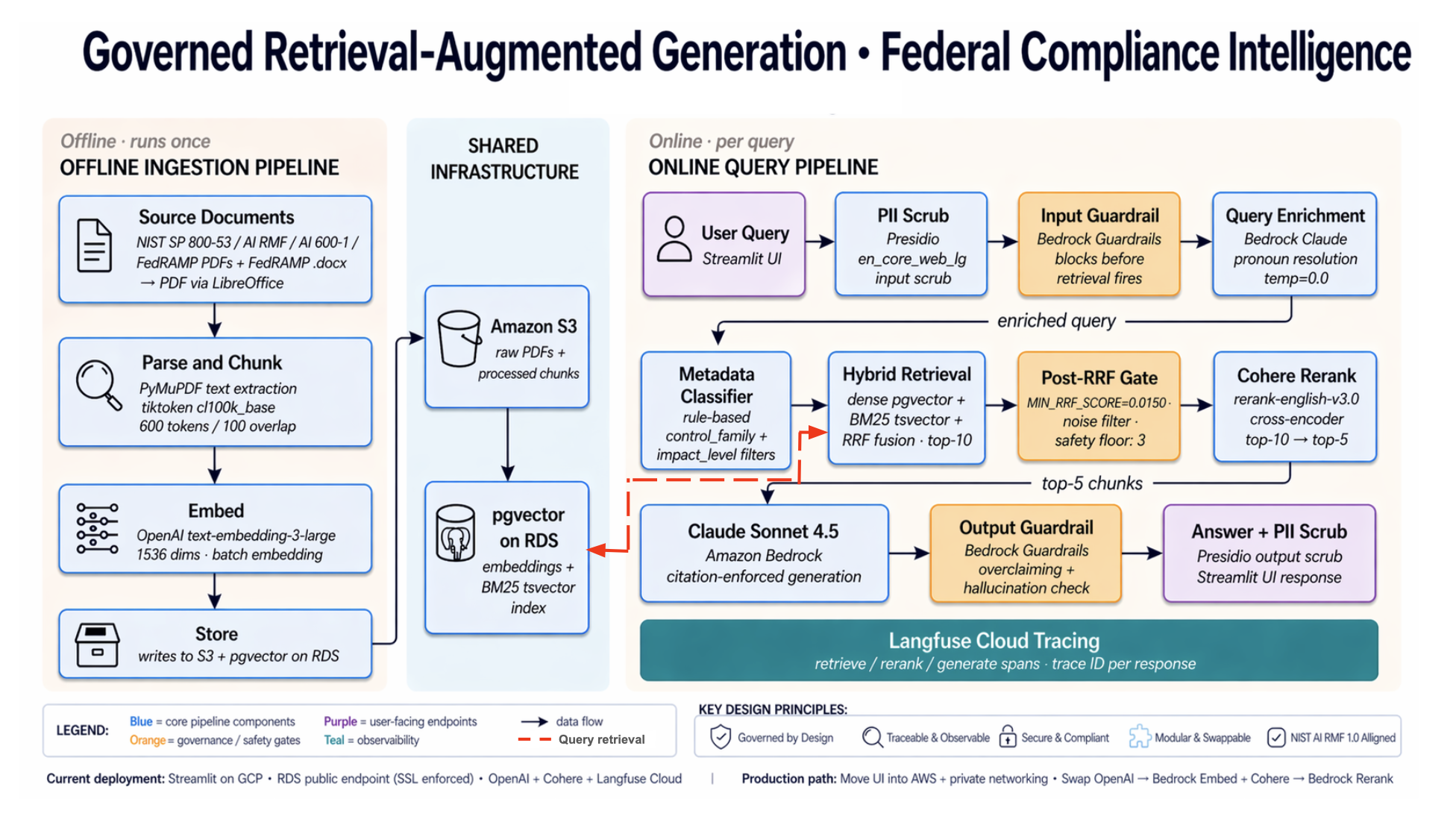
Trust-layer retrieval architecture: hybrid retrieval, reranking, PII controls, dual guardrails, and RAGAs evaluation over federal compliance corpora.
Related
- Companion article: Beyond Retrieval: Architecting the Trust Layer for Enterprise AI
- Companion project: The Trust Layer for Enterprise Agentic AI
Portfolio demonstration only. Built on public NIST and FedRAMP compliance documentation to illustrate governed RAG architecture patterns. Not affiliated with any federal agency or production system. Views and implementations are my own.
Stack
- pgvector
- BM25/RRF
- Cohere Rerank
- Amazon Bedrock (Claude Sonnet + Guardrails)
- OpenAI Embeddings
- Presidio
- Langfuse
- RAGAs
- Pydantic
- Streamlit